
The man who carried the gifts.
In March 2011, twenty NBA players gave for Japan earthquake and tsunami relief. One man carried those gifts into the disaster zone — town to town, alone, including Fukushima — and went blind doing it. The donors were honored. He was not. Fifteen years later, the record is being set straight, and the future is being funded.
Twenty players gave. They actually gave.
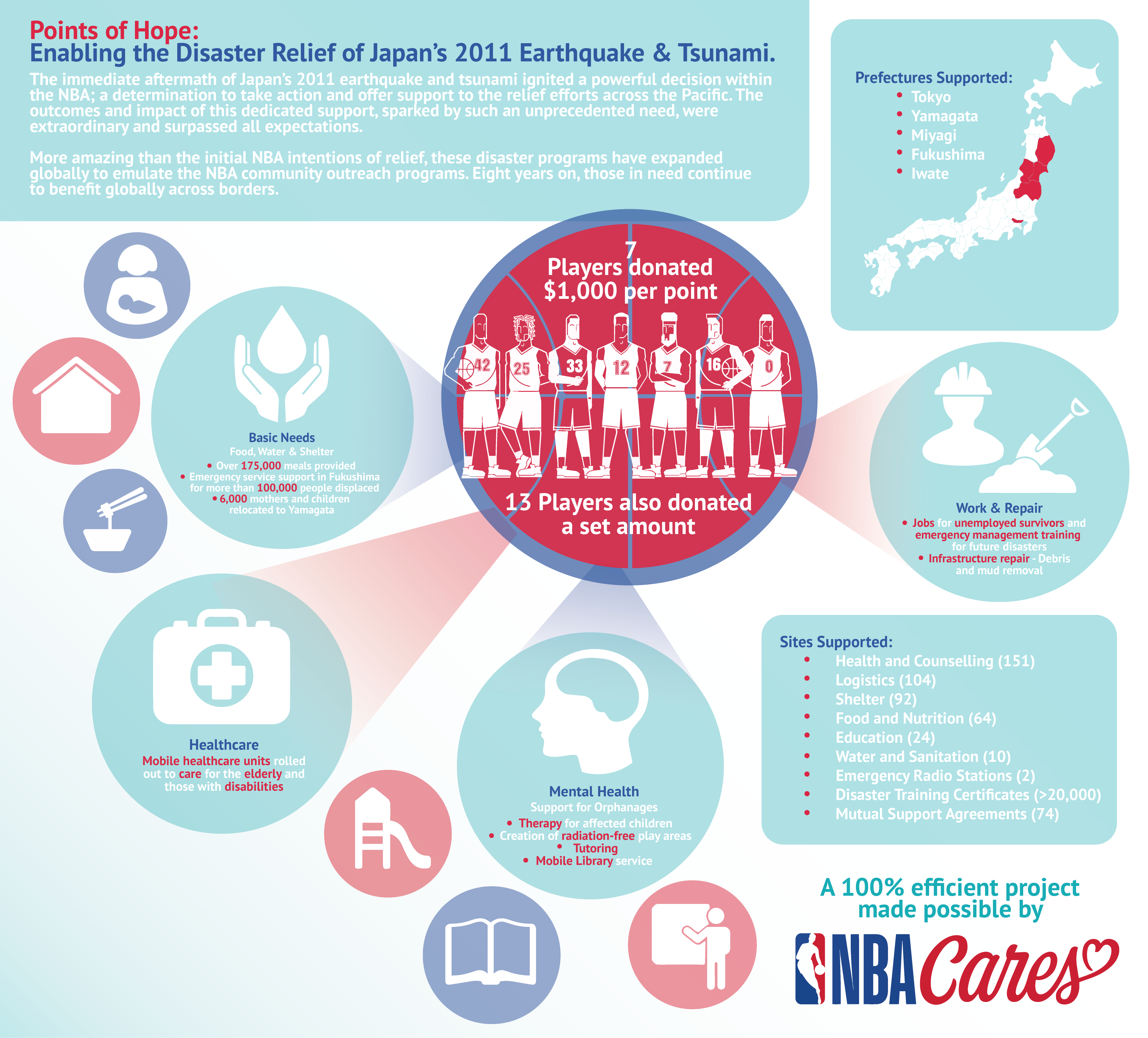
In March 2011, twenty NBA players gave for Japan relief through the Japan Relief and Recovery Fund, organized by Wasserman Media Group. Seven gave $1,000 for every point they scored in games played March 25–27 — LaMarcus Aldridge, Marc Gasol, Pau Gasol, Al Horford, JaVale McGee, Derrick Rose, and Russell Westbrook. Thirteen more gave flat donations: DJ Augustin, Jarron Collins, Jason Collins, Mike Dunleavy Jr., Tyreke Evans, Danilo Gallinari, Xavier Henry, Antawn Jamison, Jason Kapono, Quincy Pondexter, Brian Scalabrine, Etan Thomas, and Ben Wallace.
We do not call these pledges. They gave.
On the record
From: Carl Harold Williams
To: Commissioner Adam Silver, National Basketball Association
Copies: Mark Tatum, Deputy Commissioner & COO; Kathy Behrens, President,
Social Responsibility & Player Programs; Ruth Jurgensen, Executive Director, NBA Foundation;
David Kelly, Executive Director, National Basketball Players Association
Date: October 2026
Commissioner Silver,
I am owed nothing for my 22 years of military service. Those years developed me into the professional I am, and I give them full credit. I state that clearly before anything that follows — because what followed required everything those years taught me.
I was prepared.
I carried those gifts on the ground in Japan. Town to town, alone — including Fukushima. Direct Relief's own publication introduced my field report as, and I quote, "a personal From the Field story by Direct Relief Japan Recovery Coordinator, Carl Williams." I went blind for nearly a year doing that work. The medical records exist. They are mine, and they stay mine.
The donors were honored. Pau Gasol's Citizenship Award cited his Japan donation. The man who carried the gifts was not.
I asked — the head office, the teams, the coaches, the players, the fan clubs, the foundations — and the answer was silence.
So hear this plainly: the recognition you might not give, we will give ourselves. Aggressively. This letter is on the record, and it is public. I will not stop asking. The record is the record.
What I am owed is simple, and it is the floor:
- A formal written acknowledgment that I served as the ground coordinator for the 2011 players' Japan relief gifts.
- Parity of honor. The donors received the league's Citizenship Award; the man who delivered the gifts receives the league's formal citation. Same relief effort, same honor.
- The corrected record. League history materials on the 2011 Japan relief effort will name me — the coordinator the fund's own publications already named in print.
And what I am asking — for the long line of talented and determined people who need support in the United States and Japan — is the means to coach the next generation in the urgent matters no other is prepared to handle: disasters, AI-powered business models, and business continuity. Funding. Partnership. Platform. Program-related investment into TASK L3C, where donations are sought as investments and the return is public good.
Fifteen years is enough.
Respectfully,
Carl Harold Williams
Verified public record
Every claim below is either independently published or marked as Carl's own account. Personal accounts are labeled as such. Medical records exist and remain private.
Independently published
Three publications, each a search away:
- Direct Relief, "Back to Japan After the Quake" (September 2011) — his field report from Kesennuma, published under the organization's own byline naming him its Japan Recovery Coordinator. directrelief.org
- CNN, "Letters bring hope to survivors in Japan" (Kathleen Koch, March 9, 2012) — names him coordinator of JACL relief efforts. cnn.com
- "An Interview with Carl Williams from Peace Boat" (~2013) — his own account of moving from first-deployment field work to advisory and disaster-IT standards work.
- The Japan Times (August 19, 2011) — Brad Pitt publicly pointed to Direct Relief's Japan relief effort, its work with the Japanese American Citizens League, and its 100%-of-funds model, as the standard for disaster giving. japantimes.co.jp
Carl's account, on the record
- He carried the players' gifts town to town, alone — including Fukushima.
- He lost his sight for nearly a year doing that work and still receives treatment. The records are his; they stay private.
- He rarely photographed his work — until he found schoolchildren visiting the site of their destroyed school, holding their words of hope. CNN's published account places this in Iwaki City on the four-month anniversary of the tsunami; his own memory holds it as three months on. Both agree on what mattered: "This wasn't my disaster, it was theirs, and they survived."
Honor the past; fund the future.
Recognition settles the fifteen-year debt. Assistance fuels the next fifteen years of coaches. We ask for both, in that order — the backward look earns the forward look.
Recognition — the debt
The non-negotiable floor:
- Formal written acknowledgment of the ground coordination.
- Parity of honor with the donors — same relief effort, same honor.
- The corrected league record, naming the coordinator.
Assistance — the mission
Funding, partnership, and platform to coach the next generation — via program-related investment into TASK L3C, where donations are sought as investments and the return is public good.
Talk with TASKThree things the next generation must be coached in
There is a long line of talented and determined people who need support in the United States and Japan. Emergency management and business continuity do not come with desire alone — they must be coached and practiced. No other is prepared to handle what is coming in these three:
Disasters
The preparedness layer before the event — funding, coordination, and capacity already in place, so frontline organizations never start from zero.
AI-powered business models
The economic models of the augmented-intelligence era — built for public good, not extraction.
Business continuity
The discipline of keeping communities and enterprises standing through disruption — practiced, not theorized.
With care and openness
Donations in the sense of an investment — the return is public good.
Contact TASK L3C
TASK L3C · 32 N Gould St, Sheridan, WY 82801
Email: carl@tokyotaskforce.com
Or use our intake form on the Contact page.